Tuesday, May 1, 2018

Ehrman Misleads on Jesus and the Destruction of the Second Temple


I just listened to Sam Harris' recent interview with Bart Ehrman, which was just released today. In my judgment, a particular section of this interview casts aspersions on Ehrman's integrity. In this section he comes off as someone who pipes to the tune to whoever is interviewing him. I understand that this is a serious charge. So let me explain why I think this is the case.

In the section of the interview around the twenty-minute mark, Harris and Ehrman juxtapose the "modern academic dating" of the Gospels against the "fundamentalist" dating. Ehrman says that when he was a fundamentalist Christian he accepted the earlier dating of the Gospels, but that now he accepts the dating of "critical scholarship." In particular, he says the following (around 21:45):

So the deal with the modern academic dating [is that] the Gospel of Mark seems to know that the temple in Jerusalem had been destroyed by the Romans. That happened in the year 70; so probably it's written some time after the fact. But fundamentalist Christians would say that no...It's predicting that it's going to happen. [So] this Gospel [was written] well before that. And if you don't agree with that it's because you have an anti-supernaturalist bias [Ehrman then laughs].

The clear implicature in the conversation here is that the position that Mark was written prior to the destruction of the second temple is merely a fundamentalist position.
First, whatever the accurate dating of the Gospels may be, it is manifestly false that whoever believes in an early dating of the Gospels is a fundamentalist. To be fair, this is not explicitly stated by Ehrman; however, in my judgment it is the implicature of the conversation. But I invite people to listen and to judge for themselves. In any case, like I said, Ehrman's implicature here is just blatantly false. For example, J.A.T. Robinson, a scholar who famously dated all the Gospels prior to 70 A.D., was certainly no fundamentalist. An Anglican bishop, he seems to have been a proponent of universalism; needless to say, no fundamentalist is a universalist. Moreover, James Crossley, an atheist, argues that Mark was written no later than around 45 A.D. These are just two examples of non-fundamentalists who give earlier-than-70 dates to Mark. There are many more.

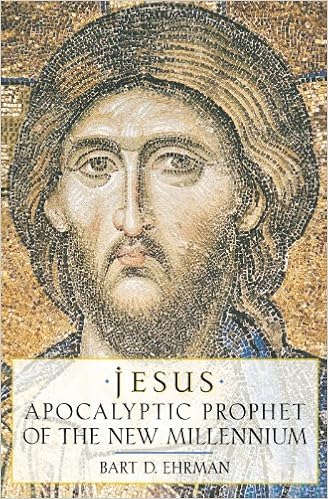
Second, unless Ehrman has recently changed his position, one which he didn't want to make known in this interview for the sake of "scoring points" against Christianity, Ehrman himself believes that Jesus predicted the destruction of the second temple! So it is very strange that he is presenting the view in a manner such that the listener gets the impression that only fundamentalists believe this. Here is a video from a lecture where Ehrman explicitly affirms Jesus' prediction, offering good arguments totally independent of so-called fundamentalist considerations.[1] True, this is a relatively old clip of Ehrman, but that clip was filmed when Ehrman had already abandoned Christianity—so he couldn't have been a fundamentalist then. Moreover, in his book, Failed Apocalyptic Prophet of a New Millenium, Ehrman also argues for the historicity of the prediction. Again, although it is a relatively old book, he was clearly not a Christian when he wrote the book. Here is the relevant excerpt:

It was this most sacred place, the dwelling of God himself, that Jesus predicted would be destroyed in the coming judgment—of this very God. Evidence is found in multiply attested traditions. The earliest surviving account is Mark 13:2: And as [Jesus] was coming out of the temple, one of his disciples said to him, "Teacher: see what great stones and what great buildings are here." And Jesus said to him, "Do you see these great buildings? Not one stone will be left upon another that will not be destroyed." In later traditions, Jesus himself is said to have threatened to destroy the place. For example, at his trial, false witnesses reputedly claimed, "We have heard him saying, 'I will destroy this temple that is made with hands and after three days build another made without hands" (Mark 14:58); and on the cross he was allegedly mocked: "Look at the one  the apocalyptic teachings of jesus who would destroy the temple and rebuild it in three days!" (Mark 15:29). Something similar is independently stated in John, where Jesus tells his Jewish opponents, "Destroy this temple and I will raise it up in three days" (John 2:19). And from an unrelated source, a speech found in the book of Acts, at the martyrdom of Stephen, false witnesses again arose to say that they had heard Stephen claim that "this Jesus the Nazarene will destroy this place and revamp the customs that Moses gave to us." Even the Gospel of Thomas gets in on the act, as Jesus there says, "I will destroy this house and no one will be able to rebuild it" (G. Thorn. 71). Thus the tradition that Jesus spoke about the destruction of the Temple is widely spread. Moreover, most of these traditions indicate that Jesus himself will have something to do with it. The idea that he would personally destroy the Temple is difficult to get past the criterion of dissimilarity: Christians who considered him the all-powerful Lord may well have given the sayings that twist in order to show that after his death, he "got even" with Jews by destroying their temple. Nor does it do well by the criterion of contextual credibility: How could a single man claim to be able to demolish an enormous set of buildings like this? Similarly problematic is the notion found only in John, that when Jesus talked about the temple being destroyed and raised in three days, he was actually speaking of his body (John 2:21). Did Jesus then speak at all about the coming destruction of the Temple? One might be tempted to push the criterion of dissimilarity a bit further, and claim that since the Temple was in fact destroyed by the Romans in 70 CE, none of the predictions of Jesus can be safely trusted as actually going back to him—that is, that later Christians put predictions of its destruction on his lips to show his prophetic powers. Most scholars, though, consider this an extreme view, since the predictions of the destruction on one level or another pass all of our criteria: (a) They are obviously multiply attested (Mark, John, Acts, and Thomas!). (b) Moreover, in one respect, at least, the earliest form of these sayings appears to pass the criterion of dissimilarity, since Jesus' claim in Mark that not one stone would be left upon another did not in fact come true, as you can see yourself by visiting the Western Wall in Jerusalem today; if anyone actually knew the details of the destruction, they wouldn't have invented this verse, (c) And, just as importantly, the sayings are completely contextually credible. For we know of other prophetic figures throughout the history of Israel who had maintained that the Jewish people had so strayed from God that he would enter into judgment with them by destroying their central place of worship [emphasis added].[2]

Well, there you have it—straight from the horse's mouth. No comment is necessary.

Third, suppose that Ehrman did actually change his mind here; suppose that now he denies the historicity of Jesus' prediction of the destruction of the second temple of Jerusalem. In this case, his position is probabilisticially inconsistent. Why? Because, as I pointed out in Part 1 of the series of whether Jesus was a failed prophet, the historicity of the Olivet Discourse is essential to the failed-prophet view. And in the Olivet Discourse, as recounted by all three of the Synoptic authors, Jesus seems to prophesy the destruction of the second temple. But given that Ehrman believes that the Synoptics were written after 70 A.D., and more than a decade afterwards in the case of Matthew and Luke, then on his view the authors had to be imputing what they believed to be false prophecies on to the mouth of Jesus. But this is very improbable. So, if he indeed now denies that Jesus actually prophesied the destruction of the second temple, then, he, as a failed-prophet theorist, cannot consistently affirm a post-70 dating for the Synoptics (note that the consistency in question I am talking about is not a logical consistency, but a probabilistic one).

So it appears that Ehrman is being highly misleading here, and/or conveniently leaving out very relevant and important facts, something which he seems to do not infrequently.

If you think that I am being uncharitable towards Ehrman, please let me know, and provide reasons to back up your claim. But I must confess that I didn't listen to the very beginning of the clip, as it just seems to be Ehrman recounting his deconversion story, something which I am already familiar with.

[1] Cf. 15:20 of "New Testament Lecture Twelve: Jesus the Apocalyptic Prophet." https://www.youtube.com/watch?v=b8nGtbAjH8E.   
[2] Bart Ehrman, Jesus: Failed Apocalyptic Prophet of a New Millennium (Oxford: Oxford University Press, 1999), 156-7.  

Tuesday, April 24, 2018

Mike Licona and Dale Martin Debate: Did Jesus Claim Divine Status?


            New Testament scholars Mike Licona and Dale Martin debated whether or not Jesus considered himself to be divine here.

First, I think that Licona’s case that Jesus believed that he was divine was far better than the counter-case made by Martin.

Second, Martin distinguishes between three Jesuses: “the historical Jesus,” “the real Jesus,” and the “the Jesus of the past.”[1] He takes “the historical Jesus” to refer to the Jesus that can be (re)constructed using historical methodologies. He takes the “real Jesus” to be, well, the real Jesus, independent of what historians tell us about him—and explicitly says that he believes the real Jesus is the second Person of the Trinity.  I am not quite sure how Martin intends to distinguish “the real Jesus” from “the Jesus of the past”; in any case, he contends that the latter is a figure that is entirely inaccessible to us who now occupy the present moment, for the past is forever gone. If you find yourself shaking your head in confusion then do not fret—it is not your fault, it is Martin’s. The simple fact of the matter is that Martin is deeply confused here. His distinctions, especially between “the real Jesus” and “the Jesus of the past,” are obfuscatory and/or unintelligible. True, historians cannot hope to find out all the facts about Jesus, but that does not mean that their historical reconstructions are not about the real flesh and blood Jesus who lived and preached approximately two millenia ago in Palestine. On Martin’s view, the “historical Jesus” must refer to a set of true propositions about the real Jesus that can be arrived at through historical methodology. So on Martin’s view, historical Jesus scholars, when seemingly writing articles and books about Jesus, are not actually writing about Jesus, but about a set of propositions! But surely this is absurd. The real Jesus simply is the historical Jesus who simply is the Jesus of the past—to state otherwise is just to engage in sophistical obfuscation.  It is noteworthy that the prominent historical Jesus scholar John P. Meier makes distinctions similar to, and as problematic as Martin’s. William Lane Craig does a good job of refuting Meir’s philosophy of history here (and let us be honest, what Martin and Meier are doing here is not history, but (bad) philosophy of history!).

Third, I note that Dale Martin is a Christian. Having listened to quite a few of his Yale Open Course lectures, I would have guessed that he was secular (in some of his lectures he makes claims such as (roughly) “the evidence is certainly not sufficient to establish the Christian faith”). However, to my surprise, he made clear in the opening address of this debate that he self-identifies as an Episcopalian Nicene Creed-believer. It is apparent from what he says in this debate that he believes in Christianity although he thinks that the historical evidence fails to establish crucial Christian doctrines like the divinity and resurrection of Christ. As someone who takes a very evidence-based approach to religion, I would say that that he is being irrational here. He should not be a Christian if that is what he believes. One should follow the evidence wherever it leads. If to one's mind one’s evidence does not sufficiently establish some proposition P, then one should not believe P. I find Martin’s self-characterized “postmodernist” position, to be, like those of scholars John Dominic Crossan and Rudolf Bultmann, utterly irrational. One should follow the evidence wherever it leads. If, as Martin believes, “the historical Jesus” probably did not believe that he was divine, then Martin should not be a Christian!

Fourth, Martin’s historical methodology is flawed. This is apparent when he is discussing whether Jesus saw himself as the Son of Man, and Licona’s evidence thereof. Licona presented a pretty compelling case from multiple independent sources that Jesus took himself to be the Son of Man (an allusion to the figure in Daniel 7:13). Martin seems to believe that this evidence is defeated. He believes that those passages where it is ambiguous that Jesus is referring to himself with the “Son of Man” locution, and where he may be referring to some other future person (an idea I find wholly implausible), are more probably authentic than the ones where he is clearly referring to himself. And this, he seems to think, defeats the evidence for Jesus’ taking himself to be the Son of Man.  His motivation for believing this is the criterion of dissimilarity.The criterion of dissimilarity states the following:


(COD): If a New Testament author A states that Jesus expressed some proposition P that is not consonant with the Jewish tradition of Jesus' time or the early Church that followed him, then A's statement to this effect is evidence that Jesus did in fact state that P. [2] 


Since Martin believes that it was consonant with the New Testament authors’ agendas to have Jesus be the Son of Man, then the fact that there are some verses where it is not clear that Jesus is using the title to refer to himself, is, by (COD), evidence of the authenticity of these verses. Now, even if we grant all this, I do not see how Martin gets from

        (1)    There are verses where Jesus does not explicitly identify himself as the Son of Man, but where he may be referring to some other future person, and the criterion of dissimilarity is true,

To

        (2)    The verses where Jesus explicitly identifies himself as the Son of Man are not authentic.

Indeed, even if the verses where Jesus does not explicitly identify himself as the Son of Man are authentic, and there is no good reason to doubt that they are, this does not imply (2). So how is Martin concluding (2) from (1)? Well, it seems that Martin is illegitimately applying the criterion of dissimilarity in a negative fashion. That is, it seems that he is using the criterion not to try to confirm some proposition, but to disconfirm some proposition. The negative principle is as follows:

(COD*): If a New Testament author A states that Jesus expressed some proposition P that is  consonant with the Jewish tradition of Jesus' time or the early Church that followed him, then A's statement to this effect is evidence that Jesus did not state that P. Because of (COD*) he believes that

       (3)    The New Testament authors’ stating that Jesus claimed to be the Son of Man when it was consonant with the teachings of the early Church--where early Church teaching includes the agenda of the Evangelists--is disconfirmation of the proposition that Jesus claimed to be the Son of Man.

So it seems that he is relying on (1) and (3) to get to (2). But the problem is that (3), and the principle undergirding it—viz., (COD*), are false. Indeed (COD*) is an absurd principle. To take an example, just because Holocaust survivors record something unfavorable to the Nazi regime, that does not mean that that very fact is disconfirmation of what they said. Just because some one states something that is consonant with one’s agenda is not a strike against what that person is saying. So (COD*) is false; (COD) may not be legitimately applied in a negative fashion. Therefore, Dale Martin’s case that Jesus did not consider himself the Son of Man fails.

[1] Cf. ~43:00.
[2] Just to be clear, in this post I take the standard line in confirmation theory that a proposition E confirms a proposition P iff Pr(P|E) > Pr(P). Likewise, I take E to disconfirm P iff Pr(P|E) < Pr(P).  

Friday, April 6, 2018

Eternity Smiles Upon Us All

Eternity smiles upon us all. There is no escape from eternity. After you die you will either cease to exist *forever,* or you will continue to exist *forever.* If the former is true, then it is probably the case that nothing you do matters. If the latter is true, then it is probably the case that everything you do matters (or almost everything). This is not a truth that is very hard to discover. But many avoid contemplating the consequence of this truth for their whole Earthly lives. (Of course, I am assuming that gappy human existence is impossible or negligibly probable).


Wednesday, April 4, 2018

The Fundamentalist Apologist and the Non-Believer

I don't buy the idea shared by quite a few Christian apologists (usually of the fundamentalist variety) that every non-Christian is either (i) not well-informed about the relevant facts, or (ii) suppressing the truth in unrighteousness. Quite frankly, this is just stupid and overly simplistic. Christianity is not obviously true (although general theism is). In fact, it's clearly not obviously true. If you think the Trinity, the incarnation, the inspiration of the Old Testament, etc., are all obviously true, then I'm afraid you suffer from excessive and overly zealous dogmatism. Some may sincerely come to think that the probability of these doctrines is very high after much study, but that doesn't mean that every sincere person will. Some people may sincerely think they have successful arguments against Christianity--yes, even people who have studied Christianity for a long time.

That being said, in my opinion most critics of Christianity are pitifully underinformed about the relevant facts, and many critics of Christianity, like Richard Carrier, clearly have some underlying personal reasons for their views (I doubt any person as well-informed as Carrier would come to sincerely believe a proposition as absurd as <Jesus didn't exist> if it were not for non-rational reasons).

Bart Ehrman's Flawed Historical Methodology: The Angels at the Tomb


I enjoy reading Bart Ehrman's books, as I think that they are generally well written, thought provoking, and informative. His books attacking Christianity stand in stark contrast to the garbage heap of sensationalist nonsense found in books by, e.g., Richard Carrier, Robert Price, and Reza Aslan (none of the works of these three are taken seriously by well-informed people). Bart Ehrman has, after all, spent decades studying and teaching the New Testament at research universities; and he is a world-class textual critic of the New Testament. There is no question that he knows what he is talking about. However, I believe that many of his arguments and methodologies are flawed. Take the following example.

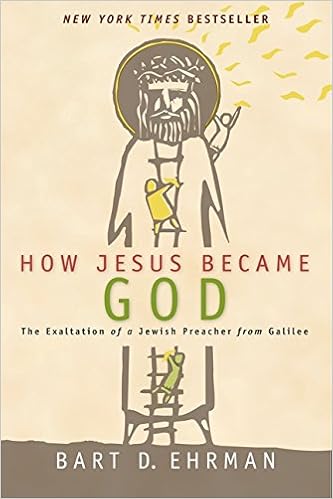
On pp.134-5 of his book, "How Jesus became God," (Harper Collins, 2014) Ehrman talks about the discrepancies and the contradictions that he alleges litter the Gospel records. Of particular interest to me is the following excerpt:

I should stress that some of these differences can scarcely be reconciled unless you do a lot of interpretive gymnastics when reading the texts. For example, what does one one do with the fact that the women apparently meet different people at the tomb? In Mark, they meet one man; in Luke, two men; and in Matthew, one angel. The way this discrepancy is sometimes reconciled, by readers who can't accept that there could be a genuine discrepancy in the text, is by saying that the women actually met two angels at the tomb. Matthew mentions only one of them but never denies there was a second one; moreover, the angels were in human guise, so Luke claims they were two men; Mark also mistakes the angels as men but mentions only one, not two, without denying there were two. And so the problem is easily solved. But it is solved in a very curious way indeed, for this solution is saying, in effect, that what really happened is what is not narrated by any of these Gospels: for none of them mentions two angels! This way of interpreting the texts does so by imagining a new text that is unlike any of the others, so as to reconcile the four to one another. Anyone is certainly free to construct their own Gospel if they want to, but that's probably not the best way to interpret the Gospels that we already have [emphasis is mine].

This is a flawed historical methodology if there ever was one. Now, I am not a fan of trying to straitjacket the gospel accounts into some implausible harmonization. However, the key word here is “implausible.” Ruling out harmonization in principle and tout court, which seems to be what Ehrman is implicitly advocating here, is simply bad historical method. Plausible harmonizations are plausible harmonizations; and implausible harmonizations are implausible harmonizations. It is the latter type of harmonizations that we should resist, not the former. Ehrman’s emboldened statements above belie his deeply flawed historical epistemology. He does not seem to understand, or he chooses to ignore, the fact that historical records are, by their very nature, limited accounts of what happened in the past. That means that no single historical record will record every event with all its details. There will always be some relevant pieces of information that the author either wittingly or unwittingly omits. When there are multiple (relatively early) accounts concerning what happened at a particular event E, the historian’s job is to critically evaluate these multiple accounts in order to ascertain a more complete picture of E. If the historian’s reconstruction of what happened at E is not identical to what any of the records say, and does not contradict them, then that is completely fine—with the proviso that the historian’s reconstruction is plausible. As is clear from the above-quoted excerpt, Ehrman seems to believe that any such attempt to use the Gospels to ascertain a more complete picture of what happened, and which is not included in any single gospel, is creating “a new text” and one’s “own gospel.” But this is simply wrongheaded. Imagine if Ehrman’s methodology were adopted by criminal prosecutors. Every time they would try to use a multiplicity of eyewitness-testimony in order to coherently reconstruct a crime scene that goes beyond any single individual testimony, they would have to remind themselves to stop, for they are coming up with “a new testimony,”—viz., “their own.” Clearly this would be a stifling and unjustified methodology on the part of these prosecutors. So there is nothing in principle that is wrong with harmonizing the gospel accounts—again, with the proviso that the harmonization is plausible.

And in this case, I think that the harmonization is eminently plausible. Some of the Gospel authors emphasized one angel over the other, and some called them men. Mark doesn’t “mistake” the angels as men, as claims the strawman-harmonizer that Ehrman sets up. Rather, Mark explicitly states that the “young man” was dressed in a white robe, traditional angelic garb; the best explanation is that he was just describing what he believed to be an angel in the guise of a man (especially given the testimony of Matthew and Luke). There is no problem here: in Judaism angels would not infrequently appear in the form of men; just look at Genesis 18 and Joshua 5. So the essential harmonization that Ehrman singles out is actually, to my mind, quite plausible. One wonders why Ehrman would single out this discrepancy when there is such a good explanation of it. Aren’t there better examples to choose from?

Tuesday, April 3, 2018

Was Jesus a Failed Apocalyptic Prophet? Part 1: General Considerations


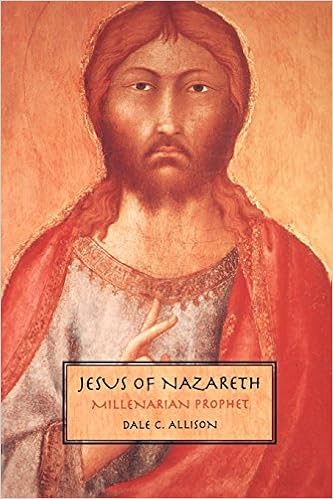
At least as far back as the writings of Heinrich Reimarus (1694 – 1768), some critical scholars of the New Testament and Early Christianity have taken the position that Jesus falsely predicted that the end of the world would come in the lifetime of his disciples. I even remember the objection being made in an off-the-cuff line in Friedrich Nietzsche's polemic, Antichrist. The work of Johannes Weis (1863 – 1914) and Albert Schweitzer (1875 – 1965) in particular made the view respectable in the halls of academe. C.S. Lewis even called Mark 13:30, where Jesus says, "truly I tell you, this generation will not pass away until all these things have taken place," the "most embarrassing verse in the bible."[1] I have long held that this is the strongest historical argument against Christianity. Indeed, my main reason for abandoning Christianity for a time was that I had come to sincerely believe that Jesus did in fact falsely predict that the end of the world would occur during the lifetime of his disciples. And obviously, if Jesus really did make such a prediction, then he was a false prophet, and clearly not divine. Moreover, the probability that God would raise such a false prophet from the dead, in effect vindicating his message, is very low indeed. I have no time to entertain the preposterous views of scholars like Wolfhart Pannenberg (1928 – 2014), who profess belief in Christianity but who think that Jesus made an importantly false prediction here. If Jesus made a false prediction here, then Christianity is false, period. So, I believe that the arguments for the failed-apocalyptic-prophet view (FPV) are ones that every sincere veritas-seeking Christian should wrestle with. For recent defenses of FPV, I recommend reading Bart Ehrman's  Jesus: Apocalyptic Prophet of a New Millenium, and Dale Allison's Jesus of Nazareth: Millenarian Prophet.


Now, whether Jesus was a failed apocalyptic prophet is a huge topic that involves an assessment of a wide variety of different items. For example, does Jesus' authentic uses of "kingdom" refer to just a future state, a la Albert Schweitzer? What does Paul mean in 1 Thessalonians 4? was he really expecting Jesus to come in his lifetime, a la Schweitzer, Bart Ehrman, et al? or did he just think that it was possible Jesus would come in his lifetime, a la Ben Witherington? are 2 Thessalonians and 2 Timothy written by Paul, and if so, what does that tell us about Paul's eschatological views? What does Jesus mean in his Olivet discourse? Was the Book of Revelations written before or after the destruction of the second temple? Was John the Baptist really an apocalyptist, or was his warnings just standard rhetoric amongst Old Testament prophets? Does Jesus' radical ethical teachings, which include teachings like "sell all you have and follow me," (Matthew 19:21) imply that he thought the end was near? Was there really a widespread belief among Christians of the very primitive church that Jesus would return in their lifetimes, or was this belief specific to some people in Thessaloniki? Is there a trend of de-apocalyptization in the New Testament? And so on and so on. Unfortunately, I do not know of any scholarly books written in English that devote themselves to comprehensively refuting the failed-apocalyptic-prophet view (FPV). The closest thing I can think of is Witherington's book, Jesus, Paul and the End of the World. This is a very strange lacuna in the literature; you would think that Christian scholars would have spent a considerable amount of time addressing this important issue. 

I was recently asked about FPV, and so I plan on writing a series of blog posts explaining why the arguments for FPV are not, in the final analysis, successful. In this first post of a series of posts, I discuss some general or a priori considerations that count against FPV. They are as follows:


1.       Given FPV, the Synoptic authors very likely wrote their Gospels before the destruction of the second temple, i.e., before 70 A.D. This is because it is implausible that they were consciously writing down what they believed were false prophecies of Jesus. This implies something important: while FPV implies that Jesus was a failed prophet, it also implies that the historicity of the Synoptics is a lot stronger than is typically granted by critical scholars of a liberal slant. FPV implies that all of the Synoptics were written within forty years of Jesus' death, well within the time of eyewitnesses of Jesus and those who knew eyewitnesses. This is a consequence of FPV that some of its proponents, like Bart Ehrman, don't want to accept. But I think they should accept this, given their view. So one consequence of FPV is that the evidence for the general reliability of the Gospels and resurrection of Jesus is stronger than it would have been if the Synoptic gospels were written after 70 A.D—and this itself somewhat lowers the probability of FPV, since the evidence for the resurrection is itself evidence against FPV (God would almost certainly not vindicate the message of a false prophet by raising him from the dead).


2.       Another point is that the proponent of FPV has to believe that Jesus did in fact correctly prophesy that the second temple would be destroyed in the generation of his disciples, even if he was wrong about the end of the world in general. Ehrman, for example, does in fact believe this. This correct prophesy is mild, though not very strong, evidence that Jesus was on a divine mission, contrary to FPV. Note that I say that the evidence is "not very strong" because while it may have been improbable for someone in Jesus' position to predict when the second temple would be destroyed (given the falsity of Christianity), it wouldn't have been that improbable; as Ehrman points out, we do have evidence of other first-century figures who prophesied the destruction of the second temple.[2] Furthermore, Messianic expectations were very high in the first century, which increases the probability that someone will prophesy an imminent confrontation with Rome.[3] So the fact that FPV implies pre-70 dates for the composition of the Synoptics itself mildly lowers the probability of FPV. 


3.       If Christianity is false, which FPV implies, then the prior probability that a first-century Jewish rabbi with the great moral teachings of Jesus would have an extremely lofty self-understanding is fairly low.  But given FPV, Jesus did have an extremely lofty impression of himself. For inextricably found in the very Olivet discourses that proponents of FPV utilize to make their points, are verses where Jesus implies that he occupies a position higher than the angels (Mark 13:32; Matthew 24:36), and where he says that even though heaven and earth pass away, his words shall never pass away (Mark 13:31; Matthew 24:35; Luke 21:33). This means that on FPV, Jesus had a very lofty and maniacal understanding of himself. So this implication lowers the probability of FPV.


4.       If Christianity is false, which FPV implies, then the prior probability that Jesus' "coming" sayings (e.g., Matthew 10:23, Mark 14:62) were meant to convey that he was going to literally "come" sometime in the future is low. This is because he was already there—with the disciples. If Christianity is false, then it isn't plausible that Jesus believed that he was going to resurrect from the dead and then come in power, or anything like that. I infer that secular scholars of the New Testament unanimously reject the idea that Jesus thought he was going to rise from the dead three days after his being executed, and then come back in glory and judge the world sometime afterwards. The prior probability of his believing and teaching something like this would be low. Again—he was already there on Earth, in Jerusalem, with the disciples. It only makes sense to see these sorts of sayings as some sort of reference to a literal future parousia if one assumes some sort of Christian understanding of Jesus, like that he taught that he was going to rise from the dead and then return one day. So it seems to me that proponents of FPV are implicitly appealing to distinctly Christians views of Jesus, ones which would be improbable given the falsity of Christianity. On a non-Christian naturalistic understanding of Jesus, his literal coming simply makes no sense. He was already there.

5.       The last point is merely that one cannot assess the question of whether or not Jesus falsely predicted that the end of the world would come in the lifetime of his disciples without  also looking at the evidence for the resurrection. Since, as I implied above, the proposition that <God vindicated Jesus' message by raising him from the dead> is probabilistically incompatible with the proposition that <Jesus predicted that the end of the world would occur in the lifetime of his disciples>, it follows that evidence for either proposition will be evidence against the other. If the evidence for the resurrection is sufficiently strong, it can overwhelm the evidence that for FPV. However, if the evidence for FPV is sufficiently strong, it can overwhelm the evidence for the resurrection, or at the least significantly lower the probability of its occurring.

So, before even looking in depth at the specific evidence for FPV, we know that there are certain probabilistic costs of the position. Someone who adopts FPV should, in order to be probabilistically consistent, adopt the view that (i) the Synoptic Gospels were all written before 70 A.D., that (ii) Jesus accurately predicted that the destruction of the second temple would occur within the lifetime of his disciples, that (iii) Jesus had and taught an extremely lofty understanding of himself, and that (iv) the prior probability that Jesus ever said that he would literally come sometime in the future is low. So the prior probability of FPV, given the falsity of Christianity, is very low. This implies that the prior probability of FPV given the falsity of Christianity is a lot lower than the prior probability of ~FPV given the falsity of Christianity. It remains to be seen whether the specific evidence for FPV will not only make FPV more likely given the falsity of Christianity, but if it will make FPV more likely simpliciter—i.e., whether the specific evidence will make FPV more probably true than false given either Christianity's truth, or its falsity.  We also made the important point that the evidence for FPV must be juxtapositioned with the evidence for the resurrection before any final assessment can be made regarding the probability of FPV. In the next post we will examine the specific evidence that comes from Jesus' famous Olivet discourse, and assess how much confirmation this evidences gives to FPV.


[1]  C.S. Lewis, "The World's Last Night" (1960).
[2] Cf., e.g, Bart Ehrman, Jesus: Apocalyptic Prophet of a New Millenium (Oxford: Oxford University Press, 1999), 157ff.
[3] Cf. e.g., N.T. Wright, The New Testament and the People of God (Minneapolis: Fortress Press, 1992), 304.

Saturday, March 31, 2018

Ehrman on the Gospels' Burial Stories


I am rereading portions of Bart Ehrman's "How Jesus became God" before Easter Sunday. Ehrman is an apostate and the most prominent contemporary scholarly critic of Christianity. In particular, I am reading the portions where he tries to undercut the resurrection. Why? I always try to read the best arguments from both sides; and I don't exempt matters of religion; I don't buy the idea that religion is simply a matter of faith. It is a matter of evidence plain and simple. If the evidence for Jesus' resurrection is sufficiently strong, then you should believe it; if it is not sufficiently strong, then you shouldn't believe it. It's really as simple as that. Many people on both sides of the debate keep being obfuscatory and keep denying this simple point--but they are wrong.

Anyways, one way Ehrman tries to undercut the veracity of the Resurrection is by attempting to show that Jesus was never buried in a well-known tomb. This would undermine the evidence for the Resurrection, for, as Ehrman says, "if there were no tomb for Jesus, or if no one knew where the tomb was, the bodily resurrection could not be proclaimed. You have to have a known tomb." This, then, is Ehrman's strategy. I should note that he used to believe that Jesus was buried in a well-known tomb, and that his tomb was found empty about three days later. But he has since come to change his mind. Here are two reasons he gives in his book for doubting the burial story of Jesus in a well-known tomb, and hence of his burial by Joseph of Arimathea.:

1. "There are numerous reasons for doubting the tradition of Jesus’s burial by Joseph. For one thing, it is hard to make historical sense of this tradition just within the context of Mark’s narrative. Joseph’s identification as a respected member of the Sanhedrin should immediately raise questions. Mark himself said that at Jesus’s trial, which took place the previous evening, the “whole council” of the Sanhedrin (not just some or most of them—but all of them) tried to find evidence “against Jesus to put him to death” (14:55). At the end of this trial, because of Jesus’s statement that he was the Son of God (14:62), “they all condemned him as deserving death” (14:64). In other words, according to Mark, this unknown person, Joseph, was one of the people who had called for Jesus’s death just the night before he was crucified. Why, after Jesus is dead, is he suddenly risking himself (as implied by the fact that he had to gather up his courage) and seeking to do an act of mercy by arranging for a decent burial for Jesus’s corpse? Mark gives us no clue.6 My hunch is that the trial narrative and the burial narrative come from different sets of traditions inherited by Mark. Or did Mark simply invent one of the two traditions himself and overlook the apparent discrepancy?"

My response: The Gospel of John says the following: "Later, Joseph of Arimathea asked Pilate for the body of Jesus. Now Joseph was a disciple of Jesus, but SECRETLY because he feared the Jewish leaders. With Pilate's permission, he came and took the body away." (John 19:38) Note the word "secretly." So Mark, in saying that "the whole council" of the Sanhedrin were against Jesus, very likely doesn't literally mean "the whole council--even the members of which who were secretly admirers of Jesus"--were against Jesus. So this point by Ehrman has no force whatsoever against the veracity of Jesus' burial by Joseph of Arimathea.

2. "In any event, a burial by Joseph [of Arimathea] is clearly a historical problem in light of other passages just within the New Testament. I pointed out earlier that Paul shows no evidence of knowing anything about a Joseph of Arimathea or Jesus’s burial by a “respected member of the council.” This datum was not included in the very early creed that Paul quotes in 1 Corinthians 15:3–5, and if the author of that creed had known such a thing, he surely would have included it, since without naming the person who buried Jesus, as we have seen, he created an imbalance with the second portion of the creed where he does name the person to whom Jesus appeared (Cephas). Thus, this early creed knows nothing about Joseph. And Paul also betrays no knowledge of him."

My response: This is an argument from silence. All four Gospels mention Joseph of Arimathea in the context of Jesus' burial. Why should we expect Paul, who is just uttering a short and ancient creed in 1 Corinthians 15, to mention Joseph of Arimathea? I don't see any good reason why we should. This is a bad argument from silence. And Paul's letters are not meant to be biographies of Jesus. They are letters, letters which presuppose a lot of facts about the life of Jesus, facts which his addressees would have been familiar with.

In conclusion, then, these two arguments that Ehrman brings up in his book against the tradition that Jesus was buried in a well-known tomb have no force at all.